The honest answer depends on who did the job, what products they used, and how Albany's winters treat your driveway. Here's what to realistically expect, and the factors that make the biggest difference.
The Honest Answer: It Depends on the Job
So how long does sealcoating last? The most common answer you'll see online is 'three to five years.' That's accurate for a quality application, but it's also a number that low-cost contractors use to make their work sound equivalent to professional work. The reality is that a cheap sealcoat might last one season. A quality application done right can protect your driveway for four to six years in Albany's climate.
The variables that determine longevity are the quality of the material, the dilution ratio, the number of coats applied, whether cracks were filled before sealing, and how much traffic and weather stress the surface sees. In the Capital Region, that last factor is significant.
Why Albany Is Hard on Sealcoating
Albany averages over 60 inches of snowfall per year and experiences some of the most dramatic freeze-thaw cycling in the Northeast. A single winter can bring dozens of freeze-thaw events: temperatures that drop below freezing overnight and rise above it during the day. Each cycle stresses the pavement surface and the sealer protecting it.
Add road salt and calcium chloride from winter maintenance, UV exposure during long summer days, and the occasional oil drip from vehicles, and you have a demanding environment for any sealcoating product. This is why material quality and proper application matter more in Albany than in milder climates.
How Long Does Sealcoating Last by Application Quality?
Low-Cost / Diluted Application
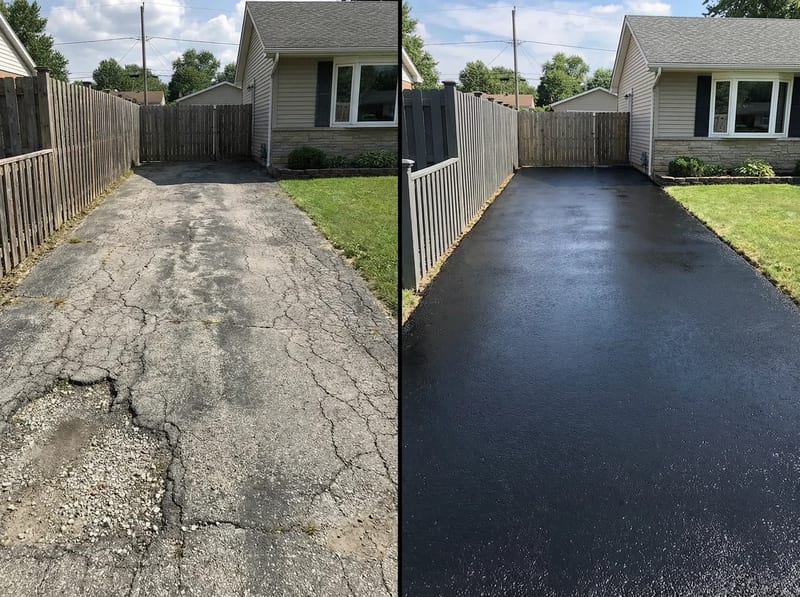
A heavily diluted product applied in a single thin coat will typically show significant wear within 12-18 months. You'll notice fading, chalking, and wear-through in high-traffic areas (where tires turn and brake) within the first season. By the second winter, the surface may look worse than it did before sealing.
Mid-Grade / Single Coat Professional Application
A single coat of professional-grade material, properly mixed and applied, will typically last two to three years in Albany's climate. This is adequate for a budget-conscious homeowner who doesn't mind resealing more frequently.
Quality Two-Coat Professional Application
A two-coat application of professional-grade material with crack filling and proper surface preparation is the standard we use at Superior Sealcoating. In Albany's climate, this typically lasts three to five years, sometimes longer on driveways with lower traffic and good drainage.
Factors That Extend Sealcoating Life
- Crack filling before application prevents water infiltration at the most vulnerable points
- Two-coat application provides the film thickness needed for durability
- Sand aggregate in the mix improves traction and UV resistance
- Proper cure time before traffic: at least 24-48 hours
- Using calcium chloride or magnesium chloride ice melt instead of rock salt in winter
- Avoiding sharp-edged snow removal tools that scratch the surface
- Keeping oil drips cleaned up, since petroleum products degrade the sealer binder
Factors That Shorten Sealcoating Life
- Diluted product: less solid content means less protection and faster wear
- Single thin coat: not enough film thickness for Albany winters
- Sealing over unfilled cracks: water infiltration continues and accelerates failure
- Application in cold or wet conditions: sealer won't bond properly below 50°F
- Heavy vehicle traffic: delivery trucks, RVs, and heavy equipment accelerate wear
- Rock salt use in winter: sodium chloride is corrosive to sealed asphalt
Our Recommendation for Albany Homeowners
For most residential driveways in the Capital Region, we recommend a professional sealcoating application every three to four years. This schedule keeps the surface protected through Albany's winters, maintains the appearance of a well-cared-for property, and is far more cost-effective than either over-sealing (which can cause buildup and cracking) or under-sealing (which allows the asphalt to degrade).
The best time to schedule is spring or early summer: after the last frost, when temperatures stay above 50°F, and before the summer heat makes the asphalt too soft for a good application. We book up fast in May and June, so reach out in April.
Get a Free Estimate and Maintenance Recommendation
We'll assess your driveway's current condition and tell you exactly what it needs. No upselling, no pressure.
How a Proper Sealcoating Job Is Done, Step by Step
-
Inspect the driveway
Walk the entire surface and mark all cracks wider than 1/8 inch. Note any areas of alligatoring, potholes, or significant oxidation (gray color).
-
Clean the surface
Blow off all loose debris with a leaf blower. Remove oil stains with a degreaser and stiff brush. Allow the surface to dry completely, at least 24 hours after any rain.
-
Fill all cracks
Apply hot-pour rubberized crack filler to all cracks wider than 1/8 inch. Allow to cure per manufacturer instructions before proceeding to sealing.
-
Apply the first coat of sealer
Apply a professional-grade, water-based sealer at the manufacturer-specified dilution ratio (typically no more than 20-25% water). Work in sections, maintaining a wet edge. Allow to dry 4-6 hours.
-
Apply the second coat
Apply a second coat perpendicular to the first for even coverage. Allow to cure 24-48 hours before foot traffic and 48-72 hours before vehicle traffic.